You Won’t Believe These Public Spaces in the Galapagos
When I first stepped onto the volcanic shores of the Galapagos, I expected wildlife—and got that in spades. But what truly blew my mind were the public spaces: open trails, shared boats, island plazas where humans and animals coexist. No fences, no barriers—just raw, unfiltered nature. This isn’t your typical park or plaza. It’s a living, breathing ecosystem where every path feels like a shared conversation between people and penguins. The moment you arrive, you realize you’re not just visiting a protected area—you’re stepping into a carefully balanced world where human presence is allowed only as long as it doesn’t dominate. The Galapagos Islands offer something rare: public spaces designed not solely for people, but for shared existence with the natural world.
First Encounter: Landing on a Living Island
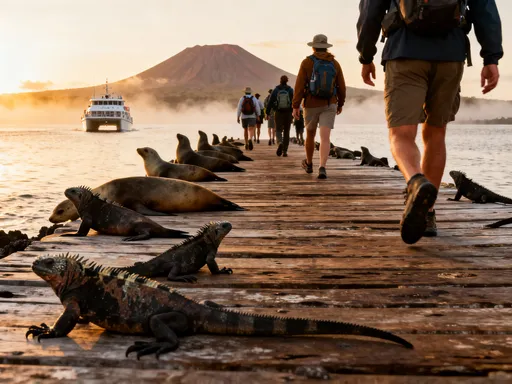
The journey into the Galapagos begins the moment your boat approaches the shore. Whether arriving at Santa Cruz or San Cristóbal, the first public space visitors encounter is the dock—a simple structure built not for grandeur, but for function and minimal impact. There are no bustling terminals or sprawling ports. Instead, wooden planks extend just far enough to allow safe disembarkation, often with sea lions already sprawled across the edges, indifferent to the arriving travelers. This immediate overlap of human infrastructure and wild inhabitants sets the tone for the entire experience. The dock is not a barrier between land and sea, but a threshold where both worlds meet.
From the dock, most visitors move toward a small visitor center, often operated in partnership between the Galapagos National Park and local authorities. These centers serve as orientation hubs, providing maps, conservation updates, and mandatory briefings on responsible behavior. What makes them unique is how seamlessly they integrate into the landscape. Built with local materials and elevated to reduce ground disturbance, they are designed to blend rather than dominate. Informational panels are written in both Spanish and English, ensuring accessibility for international travelers while respecting the islands’ national identity. Rangers, many of whom were born on the islands, guide newcomers with pride and precision, reinforcing that this is not a tourist attraction, but a shared stewardship.
The mix of people at these entry points is telling. Alongside international tourists with cameras and hiking shoes, you’ll find local fishermen mending nets, schoolchildren on field trips, and researchers carrying equipment. This diversity underscores a core principle: the public spaces of the Galapagos are not reserved for visitors. They are lived-in, used daily by residents whose lives depend on the health of the ecosystem. This shared access is not accidental—it’s intentional. By allowing locals to remain central to these spaces, the islands avoid becoming museum-like preserves frozen in time. Instead, they remain dynamic, evolving communities where conservation and daily life are interwoven.
What makes this model successful is its foundation in ecological respect. Every design choice—from the placement of pathways to the limitation of construction materials—prioritizes the protection of native species. Marine iguanas bask on sun-warmed rocks just meters from foot traffic. Sally Lightfoot crabs scuttle across tidal zones visible from the boardwalk. The absence of barriers is not a lack of control, but a testament to careful planning. Visitors quickly learn that stepping off the path isn’t just discouraged—it’s a violation of a deeper agreement between humanity and nature. This first encounter teaches a powerful lesson: public space in the Galapagos is not about human convenience, but about coexistence.
The Boardwalks That Connect: Trails as Public Pathways
Scattered across the archipelago’s major visitor islands are networks of raised boardwalks that function as the primary public pathways for exploration. On North Seymour, Isabela, and Santa Fe, these elevated trails wind through arid zones, mangrove forests, and coastal cliffs, offering unparalleled access to wildlife while minimizing environmental impact. Unlike traditional hiking trails that cut into the earth, these boardwalks are engineered to float above sensitive terrain, supported by lightweight pilings that avoid root systems and prevent soil compaction. Their design reflects a philosophy where infrastructure serves nature, not the other way around.
Walking these paths feels like moving through a living exhibit. On North Seymour, the trail passes within meters of blue-footed booby nesting sites, where pairs perform their iconic mating dance with comical precision. The birds barely flinch as visitors pause to watch. On Española, the boardwalk leads to a cliffside colony of Nazca boobies, their sharp calls echoing over the surf. The proximity is astonishing, yet never feels invasive—because the trail’s route has been carefully calculated to respect animal behavior patterns. Rangers monitor nesting seasons and adjust access when necessary, ensuring that tourism does not disrupt breeding cycles.
Accessibility is another hallmark of these public walkways. Designed to accommodate a range of physical abilities, many trails feature gentle gradients, handrails, and rest areas shaded by native Palo Santo trees. Signage is minimal but effective, using symbols and short descriptions to convey rules and points of interest without overwhelming the senses. This thoughtful design ensures that families, older travelers, and those with mobility challenges can participate fully in the experience. It reflects a commitment to inclusivity—not just among human visitors, but between humans and the environment they are visiting.
What makes these boardwalks more than just functional paths is their role as educational conduits. Along the way, strategically placed observation points highlight ecological relationships: how lava cacti stabilize volcanic soil, how frigatebirds rely on thermals to soar without flapping, how tidal pools support entire micro-ecosystems. These moments of insight transform a simple walk into a narrative journey. The trail becomes a story of adaptation, resilience, and interdependence. Visitors don’t just see wildlife—they begin to understand it. And in that understanding, a deeper sense of responsibility takes root. The boardwalks, in essence, are not just routes through nature—they are bridges to awareness.
Harbors and Marinas: Where Community Meets Conservation
The harbors of the Galapagos are more than logistical hubs—they are vibrant public spaces where the rhythms of local life intersect with the flow of tourism. In Puerto Ayora, the main pier on Santa Cruz Island, the morning brings a flurry of activity: fishing boats return with their catch, their decks glistening with silvery tuna and sea bream. Nearby, tour operators prepare Zodiacs for the day’s excursions. Travelers in sun hats and reef-safe sunscreen board vessels for island-hopping tours, while local vendors sell fresh juice and handmade souvenirs from shaded stalls. The harbor buzzes with energy, yet it operates under strict environmental regulations that ensure sustainability remains at the forefront.
What sets these coastal spaces apart is their dual identity. They are working waterfronts, essential to the livelihoods of island residents, yet they also serve as gateways for thousands of visitors each year. This balance is maintained through careful zoning and oversight. Fishing zones are clearly delineated and monitored to prevent overharvesting. Waste disposal protocols are rigorously enforced—no plastics are allowed to enter the water, and all vessel waste must be processed onshore. Even the fueling of boats follows strict guidelines to prevent spills in the fragile marine environment. These measures are not hidden—they are visible, communicated through signage and daily practice, reinforcing that conservation is not a secondary concern, but the foundation of all activity.
The pier itself functions as a social nexus. Locals gather in the late afternoon, sitting on the seawall to watch the sunset, children playing nearby, dogs napping in the shade. Tourists often join them, drawn by the authenticity of the scene. There are no artificial attractions—no amusement parks or commercial plazas. Instead, the natural beauty of the setting, combined with the genuine rhythm of community life, creates a compelling public experience. Restaurants along the waterfront serve ceviche made from sustainably caught fish, their outdoor seating spilling onto the promenade. The air carries the scent of salt, grilled fish, and flowering mangroves—a sensory reminder of the island’s interconnected systems.
Perhaps most importantly, these harbors exemplify how economic activity and environmental protection can coexist. The tourism economy supports local jobs—from boat captains to chefs to artisans—while the conservation framework ensures that the natural assets driving that economy remain intact. This synergy is not accidental. It is the result of decades of policy development, community engagement, and scientific monitoring. The Galapagos National Park, in collaboration with local government and NGOs, continuously evaluates the impact of human activity and adjusts regulations accordingly. The harbor, therefore, is not just a place of transit—it is a living example of sustainable development in action.
Plazas with a Purpose: Town Centers in the Middle of Nowhere
In the heart of Puerto Ayora, nestled between low-rise buildings and swaying palm trees, lies the town’s central plaza—a modest but vital public space. Unlike the grand plazas of mainland cities, this one is simple: a patch of grass, a few benches, a bandstand, and a statue honoring Charles Darwin. Yet its significance extends far beyond aesthetics. This plaza is where islanders gather for festivals, where families picnic on weekends, where travelers pause to rest between museum visits. And often, it’s where marine iguanas sunbathe on the cobblestones, completely at ease among the foot traffic.
These small-town plazas are intentionally designed to foster connection—between people, and between people and nature. Shaded by native trees, they offer respite from the equatorial sun. Benches are arranged to encourage conversation, not just solitary rest. Open lawns allow children to play, dogs to run, and community events to unfold. The integration of wildlife into this space is not staged—it is natural. Iguanas, birds, and even the occasional sea lion pup wander in from nearby shores, treated as part of the community rather than intruders. Locals do not shoo them away; instead, they move around them with quiet respect, a daily practice of coexistence.
The plaza also serves an educational function. Nearby, the Charles Darwin Research Station draws thousands of visitors annually, but the plaza itself acts as an informal extension of that mission. Informational kiosks, maintained by local schools and conservation groups, display updates on giant tortoise breeding programs, invasive species control, and climate monitoring. Children participate in clean-up days, planting native species and learning about the importance of their environment. These activities reinforce a culture of stewardship that begins in childhood and extends throughout life.
What makes these plazas unique is their role in shaping community identity. In a remote archipelago with limited resources and isolation from the mainland, public spaces become anchors of social cohesion. They are places where decisions are discussed, traditions are celebrated, and resilience is built. At the same time, they model a vision of urban life that prioritizes nature. There are no concrete jungles here—no sprawling parking lots or high-rises. Instead, development is constrained by law, ensuring that green spaces, wildlife corridors, and ocean views remain accessible to all. The plaza, in this context, is not just a recreational area—it is a statement of values.
Liveaboards as Floating Public Spaces
For many visitors, the most immersive experience in the Galapagos comes not on land, but at sea—aboard liveaboard vessels that serve as floating public spaces. These multi-day cruise boats are more than transportation; they are carefully designed environments that foster community, education, and minimal environmental impact. With capacities ranging from 16 to 100 passengers, these vessels follow strict itineraries approved by the Galapagos National Park, ensuring that no single area is overvisited. The experience they offer is not one of luxury isolation, but of shared exploration and collective responsibility.
The layout of a typical liveaboard emphasizes communal interaction. Passengers dine together in a central salon, where meals are served buffet-style using locally sourced ingredients whenever possible. Briefings take place on the upper deck, where naturalist guides use maps and binoculars to prepare guests for the next day’s excursion. Dive prep zones on the stern allow snorkelers and divers to gear up together, sharing excitement and safety tips. Even cabins, while private, are modest in size, reinforcing that the focus is on the outside world, not onboard amenities. This design philosophy turns the vessel into a micro-society, where conversation flows easily and bonds form quickly among travelers from different countries.
Crew members—many of whom are Galapagueños—play a crucial role in shaping the experience. They are not just service providers but educators and ambassadors. During meals, they share stories of island life, from childhood memories of swimming with sea turtles to concerns about plastic pollution. Their presence ensures that the human dimension of conservation remains visible. Passengers don’t just learn about sustainability—they see it practiced daily, from the composting of food waste to the use of solar-powered systems and low-flush toilets.
Perhaps the most significant advantage of liveaboards is their ability to reduce land-based impact. By sleeping at sea, travelers minimize their footprint on fragile island ecosystems. There is no need for large hotels, paved roads, or extensive utilities. Instead, the vessel moves quietly from one anchorage to the next, allowing each site to recover between visits. This mobility extends the concept of public access without compromising preservation. It demonstrates that thoughtful design can enable deep engagement with nature while protecting it for future generations. The liveaboard, in this sense, is not just a boat—it is a model of sustainable mobility.
How Rules Shape the Experience: The Invisible Infrastructure
Beneath the apparent freedom of the Galapagos’ public spaces lies a robust framework of rules—what might be called the invisible infrastructure of conservation. These regulations are not arbitrary; they are science-based, adaptive, and rigorously enforced. Visitor numbers are capped annually, with permits required for all tour operators. Each island has designated visitor sites, and access is limited to specific routes and times. Guided tours are mandatory—no one is allowed to explore alone. These measures ensure that human presence remains controlled, predictable, and non-disruptive to wildlife.
One of the most effective tools is the zoning system established by the Galapagos Marine Reserve and the National Park. Areas are classified based on sensitivity: some are open for tourism, others for scientific research, and some are completely closed to human entry. This spatial planning allows ecosystems to recover while still offering rich experiences to visitors. For example, Punta Vicente Roca on Isabela Island is a prime snorkeling site, but access is limited to certain days and vessel sizes to prevent overcrowding. Similarly, breeding seasons for key species trigger temporary closures, ensuring that critical life stages proceed undisturbed.
The role of naturalist guides cannot be overstated. Trained and certified by the park service, they are the frontline enforcers of these rules. They monitor group behavior, maintain safe distances from animals, and educate visitors in real time. A well-placed hand signal can stop a tourist from stepping on a lava lizard’s habitat. A quiet explanation can turn a curious stare into a moment of learning. Their presence transforms regulations from restrictions into meaningful practices. Visitors don’t feel policed—they feel guided toward a deeper understanding.
What’s remarkable is how these rules enhance, rather than diminish, the experience. Because the environment remains pristine, wildlife is abundant and unafraid. Because crowds are managed, moments of solitude and wonder are possible. Because access is structured, every visitor receives a high-quality, educational encounter. The system proves that freedom in nature is not the absence of rules, but the result of them. The invisible infrastructure, in other words, is what makes the visible magic possible.
Why This Model Matters Beyond the Galapagos
The public spaces of the Galapagos offer more than just a travel destination—they present a radical reimagining of how humans can share space with the natural world. In an era of urban expansion, biodiversity loss, and climate crisis, the islands demonstrate that coexistence is not only possible but enriching. Their model challenges the conventional separation between ‘people places’ and ‘wild places,’ proposing instead a future where the two are designed together. What if city parks were planned with native species as equal stakeholders? What if waterfront developments prioritized marine life as much as recreation? The Galapagos suggests that such visions are not utopian—they are practical, tested, and effective.
This approach has implications far beyond ecotourism. Urban planners, architects, and policymakers can draw lessons from the islands’ emphasis on low-impact design, community involvement, and science-based management. The boardwalks inspire green infrastructure projects in coastal cities. The harbor regulations inform sustainable port development worldwide. The plaza model offers a template for creating inclusive, nature-integrated public spaces in even the densest cities. And the liveaboard concept points toward decentralized, mobile alternatives to mass tourism that reduce strain on fragile environments.
At its core, the Galapagos model is about respect—respect for ecological limits, for local knowledge, and for future generations. It shows that when public spaces are designed with humility and foresight, they can become places of healing, learning, and connection. The presence of a sea lion on a bench, a bird nesting beside a trail, or a child feeding a tortoise under supervision is not a novelty. It is a sign of balance restored. It is proof that humans can belong to nature without dominating it.
As more destinations face the pressures of overtourism and environmental degradation, the Galapagos stands as a beacon. Its public spaces are not perfect—challenges like invasive species, climate change, and population growth persist. But the commitment to adaptive, inclusive, and science-driven stewardship remains strong. The islands remind us that public space should not be measured only by how many people it serves, but by how well it serves all life. What if, around the world, we began to design not just for people, but with nature as an equal citizen? The Galapagos has already begun. The rest of us have much to learn.