You Won’t Believe What I Found in Plovdiv’s Hidden Corners
Tucked away in Bulgaria’s sunlit hills, Plovdiv isn’t just Europe’s oldest city—it’s a living canvas. I wandered beyond the guidebooks and stumbled on street art tucked in alleyways, centuries-old houses whispering stories, and local artists turning forgotten spaces into magic. This isn’t your typical tourist trail. It’s raw, real, and rich with culture. If you crave authentic art and soulful vibes, Plovdiv’s offbeat pulse will blow you away.
Discovering Plovdiv’s Double Identity
Plovdiv stands as a rare urban marvel where time doesn’t move in a straight line but folds back on itself, layering epochs into a single, breathing cityscape. With roots stretching over 8,000 years into the Neolithic era, it predates Rome and Athens, yet feels startlingly contemporary. Its hills rise like ancient sentinels over a city that honors its Thracian foundations, Roman grandeur, and Ottoman elegance without freezing them behind glass. The Roman Stadium, partially unearthed beneath modern buildings, still echoes with history, while the cobbled lanes of the Old Town cradle 19th-century National Revival houses painted in ochre, rose, and deep walnut.
Yet what makes Plovdiv extraordinary is not merely its past, but how it reimagines it. Unlike cities that preserve history as museum pieces, Plovdiv treats heritage as raw material for reinvention. Artists, designers, and community collectives breathe new life into abandoned warehouses, crumbling courtyards, and forgotten passageways. This dynamic interplay between preservation and innovation creates a cultural rhythm that feels both grounded and forward-moving. The city does not perform authenticity—it lives it, quietly and confidently.
Walking through Plovdiv, one senses a city in conversation with itself. The past is not silenced by progress, nor is modernity dismissed as intrusion. Instead, a mural of a mythological Thracian horseman might gaze down from a wall beside a repurposed Ottoman bathhouse now hosting jazz nights. This double identity—ancient and avant-garde—invites travelers to look beyond surface-level tourism and engage with a place that evolves through creativity. For those willing to explore beyond the brochure, Plovdiv offers a deeply personal kind of discovery.
The Old Town’s Quiet Rebellion
The Old Town of Plovdiv, perched on three of the city’s seven historic hills, is often celebrated for its pastel-colored mansions and panoramic views. But beyond the postcard-perfect facades lies a quieter, more intimate revolution—one led not by architects or city planners, but by artists and visionaries reclaiming space for expression. Here, the rebellion isn’t loud or political; it’s poetic, subtle, and deeply human. Courtyards once used for drying laundry or storing wine now house pop-up exhibitions, while basements beneath centuries-old homes have been transformed into intimate galleries showcasing experimental photography and mixed-media installations.
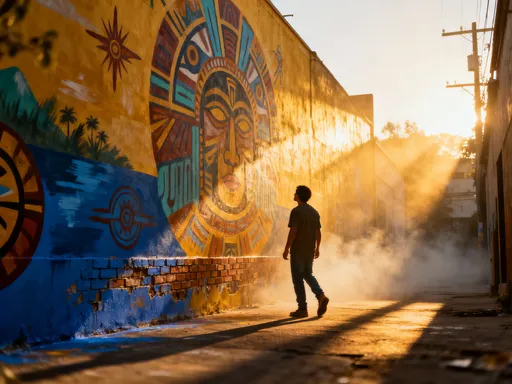
One such discovery is the courtyard of the Kuyumdzhioglu House, a National Revival-era residence that now functions as a cultural center. Behind its ornate wooden balconies, a narrow alley opens into a sun-dappled space where a mural of blooming quince trees—symbolic in Bulgarian folklore—spreads across a once-dull wall. Nearby, a disused well has been reimagined as a sound art installation, where wind chimes echo softly with the breeze, creating a meditative soundtrack for passersby. These interventions do not overpower the historic fabric; they complement it, adding layers of meaning and emotion.
What sets this transformation apart is its respect for context. Unlike cities where modern art clashes with tradition, Plovdiv’s creators listen to the architecture, responding to its textures, colors, and stories. A painter might use pigments derived from local soil, while a sculptor repurposes salvaged wood from demolished buildings. This dialogue between old and new fosters a sense of continuity rather than disruption. For the visitor, it means every turn reveals not just beauty, but narrative—a sense of being privy to a quiet, ongoing conversation between generations.
Street Art Beyond the Main Streets
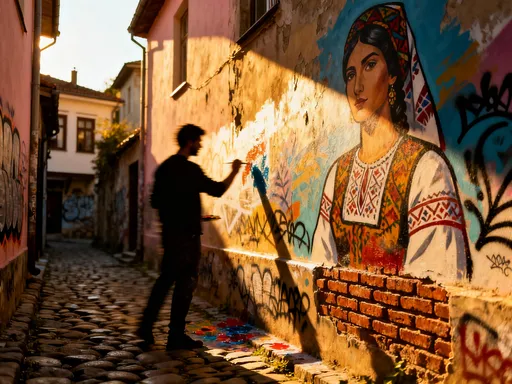
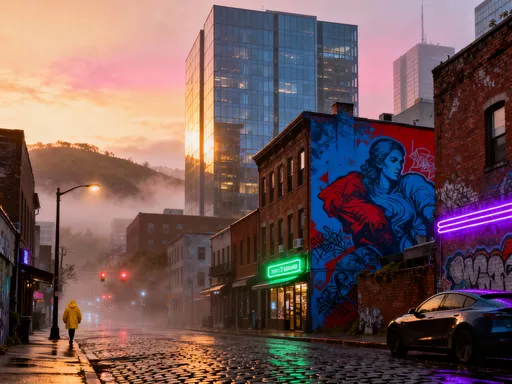
If the Old Town whispers its artistry, the Kapana District shouts it—colorfully, boldly, and unapologetically. Known as “The Trap” for its maze-like streets, Kapana has emerged as Plovdiv’s creative nerve center, where abandoned factories and underused storefronts have become canvases for a thriving street art movement. This is not graffiti as vandalism, but as visual storytelling—a language of murals, stencils, and installations that reflect Bulgaria’s complex identity, from rural traditions to urban resilience.
Wander through Kapana’s alleys, and you’ll encounter a 30-foot painting of a woman weaving a carpet, her threads morphing into digital circuits—a tribute to the fusion of craft and technology. Another wall depicts a flock of storks, Bulgaria’s national bird, soaring over a cityscape that blends medieval towers with solar panels. These works are not commissioned by corporations or sanitized for tourists; they emerge from local collectives, often in collaboration with international artists during annual festivals like the Plovdiv Street Art Meeting. The result is a constantly evolving open-air gallery, where art feels alive and participatory.
Equally compelling are the smaller, more spontaneous interventions. A broken doorway might be framed with painted ivy, suggesting a secret garden beyond. An empty lot becomes a temporary sculpture park during summer, featuring wire figures dancing in the wind. Even utility boxes are transformed into mini-masterpieces, painted with folk patterns or whimsical animals. The community embraces this creativity, with café owners welcoming murals on their walls and residents organizing clean-up days that double as art walks. In Kapana, art isn’t something you go to see—it’s something you live within.
Meeting the Makers: Artists in Their Element
To understand Plovdiv’s soul, one must meet the people who shape it. In a tucked-away studio near the Roman Forum, I met Elena, a ceramicist who blends ancient Thracian pottery techniques with minimalist modern design. Her hands, dusted with clay, moved with quiet precision as she shaped a vase on the wheel. “My grandmother made these same forms,” she said, “but I use them to speak about silence in a noisy world.” Her pieces, fired in a small kiln behind her home, are sold in local design shops and occasionally exhibited in Sofia, but she refuses to mass-produce. “Each one must have breath,” she explained.
Not far away, in a former textile workshop, a collective of painters known as “The Seventh Hill” opens their doors every Saturday. Here, artists work side by side, sharing brushes, ideas, and stories. One, a former engineer named Georgi, paints surreal landscapes where Plovdiv’s hills float above the clouds, dotted with tiny houses made of music notes. “I spent my life solving problems,” he said with a smile. “Now I enjoy asking questions through color.” Visitors are welcome to sit, observe, or even try a brushstroke under guidance. These informal ateliers are not performance—they are community.
For travelers, the opportunity to engage directly with creators is transformative. Several studios offer hands-on workshops, from traditional egg painting during spring festivals to urban sketching tours led by local illustrators. One particularly memorable experience was a natural dye workshop held in a garden behind a 19th-century house, where we learned to extract color from onion skins, walnut shells, and wild madder root. The instructor, a botanist and textile artist, spoke of color as memory—how certain hues evoke childhood, seasons, or regional identity. These moments, rich with dialogue and tactile learning, offer a depth of cultural connection that no guided tour can replicate.
Festivals That Turn the City Into a Stage
Plovdiv’s artistic spirit reaches its peak during seasonal festivals, when the entire city becomes a stage for spontaneous creativity. The most enchanting of these is the Night of Museums, held each May, when galleries, churches, and even private homes open their doors after dark. Streets fill with soft lantern light, musicians play in courtyards, and performance artists emerge from shadows—dancers in flowing white garments moving silently through the Roman amphitheater, or poets reciting verses in Bulgarian and English beneath vine-covered arches.
Equally vibrant is the One Fest, a multidisciplinary arts festival that transforms Kapana into a 48-hour celebration of music, theater, and visual art. Abandoned buildings become immersive installations; a disused tram station hosts a sound-and-light show; and rooftop terraces turn into intimate concert halls. What distinguishes these events is their accessibility—most activities are free, and there’s no formal program. You follow the music, the scent of grilled cheese from a food truck, or the laughter spilling from an open door. It feels less like attending a festival and more like being invited into a city’s private celebration.
These gatherings reveal a side of Plovdiv that daylight often hides. The city slows, breathes, and opens up. Locals mingle with visitors, sharing wine and stories. An elderly couple might invite you to join their table for a taste of homemade rakia, while a group of students performs a shadow puppet show in a narrow alley. The boundaries between performer and audience dissolve. In these moments, Plovdiv isn’t just displaying culture—it’s living it collectively, generously, and without pretense. For the traveler, it’s a rare gift: the feeling of belonging, even if only for a night.
Practical Magic: How to Explore Like a Local
To truly experience Plovdiv’s artistic heartbeat, one must shed the habits of conventional tourism. This is not a city for checklist travelers or those seeking polished attractions. Instead, it rewards slowness, curiosity, and a willingness to get lost. The best time to visit is late spring or early autumn, when temperatures are mild, festivals are in full swing, and the summer crowds have yet to arrive. Mornings are ideal for exploring the Old Town, when sunlight filters through plane trees and the air carries the scent of fresh bread from corner bakeries.
Navigation is best done on foot. Public transport exists, but the city’s magic lies in its hidden corners—alleyways too narrow for cars, staircases winding between hills, courtyards accessible only through unmarked doors. A simple map won’t suffice; instead, follow your instincts. If a mural catches your eye, follow the street it’s on. If you hear music drifting from an open window, pause and listen. Many of Plovdiv’s best discoveries are unplanned.
To go deeper, seek out artist-led walking tours, often advertised in independent cafés or through local cultural centers. These guides—painters, historians, or musicians—share stories you won’t find online, pointing out subtle details like a hidden symbol carved into a stone lintel or a forgotten fountain recently restored by volunteers. Supporting independent galleries and studios is another way to engage meaningfully. Many artists welcome visitors during open studio weekends, and purchasing a small piece—a print, a handmade journal, a ceramic bowl—becomes a tangible connection to the city.
Most importantly, say yes. Yes to the invitation to a rooftop gathering. Yes to trying a dish you can’t pronounce. Yes to sitting quietly in a sunlit courtyard, watching shadows shift across a painted wall. Plovdiv reveals itself not through effort, but through presence.
Why Plovdiv Changes How You See Culture Travel
Plovdiv does not impress with scale or spectacle. There are no towering monuments designed to awe, no luxury boutiques lining the streets. Instead, it moves you through intimacy, texture, and authenticity. It challenges the modern traveler’s instinct to document, rank, and move on. Here, the most powerful experiences are often the quietest—a shared smile with a potter, the hush of a candlelit church during a midnight concert, the surprise of finding a poem stenciled on a backstreet wall.
In a world where many destinations feel increasingly homogenized—where every city center boasts the same chain stores and filtered Instagram spots—Plovdiv stands as a quiet revolutionary. It proves that culture is not something to be consumed, but something to be felt. It reminds us that art doesn’t need grand institutions to thrive; it flourishes in alleyways, kitchens, and shared spaces when given room to breathe. This is cultural travel redefined: not as a series of sights, but as a series of connections.
Leaving Plovdiv, I carried no souvenir bags or photo albums filled with landmarks. Instead, I carried a sense of having been seen, of having participated in something real. The city had not performed for me—it had welcomed me. And in doing so, it changed my understanding of what travel can be. It’s not about escaping life, but about finding deeper currents within it. If you’re ready to trade perfection for authenticity, noise for meaning, and distance for connection, then Plovdiv awaits—not as a destination, but as a conversation.